> ## Documentation Index
> Fetch the complete documentation index at: https://www.mintlify.com/docs/llms.txt
> Use this file to discover all available pages before exploring further.
# Desktop app
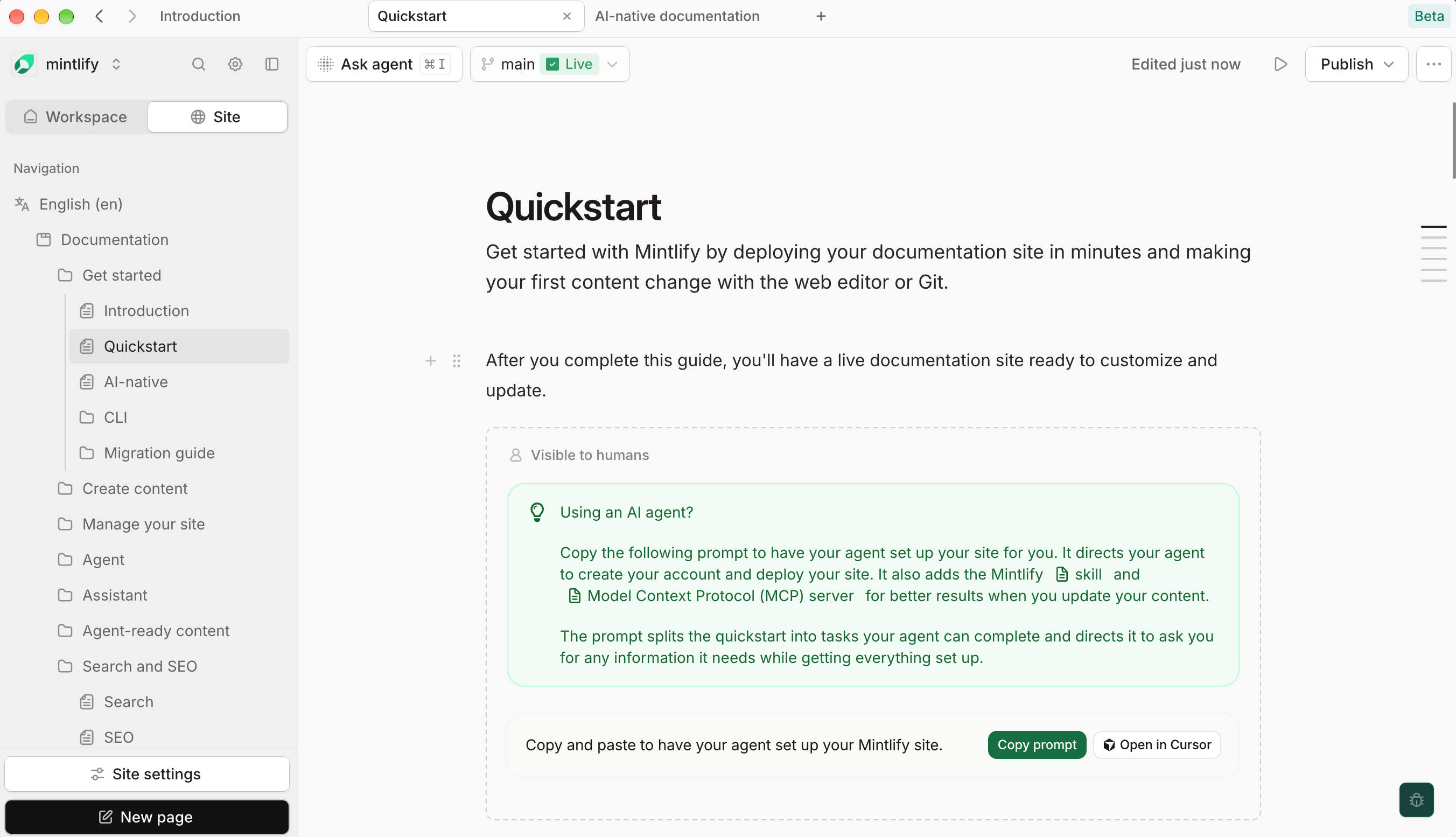
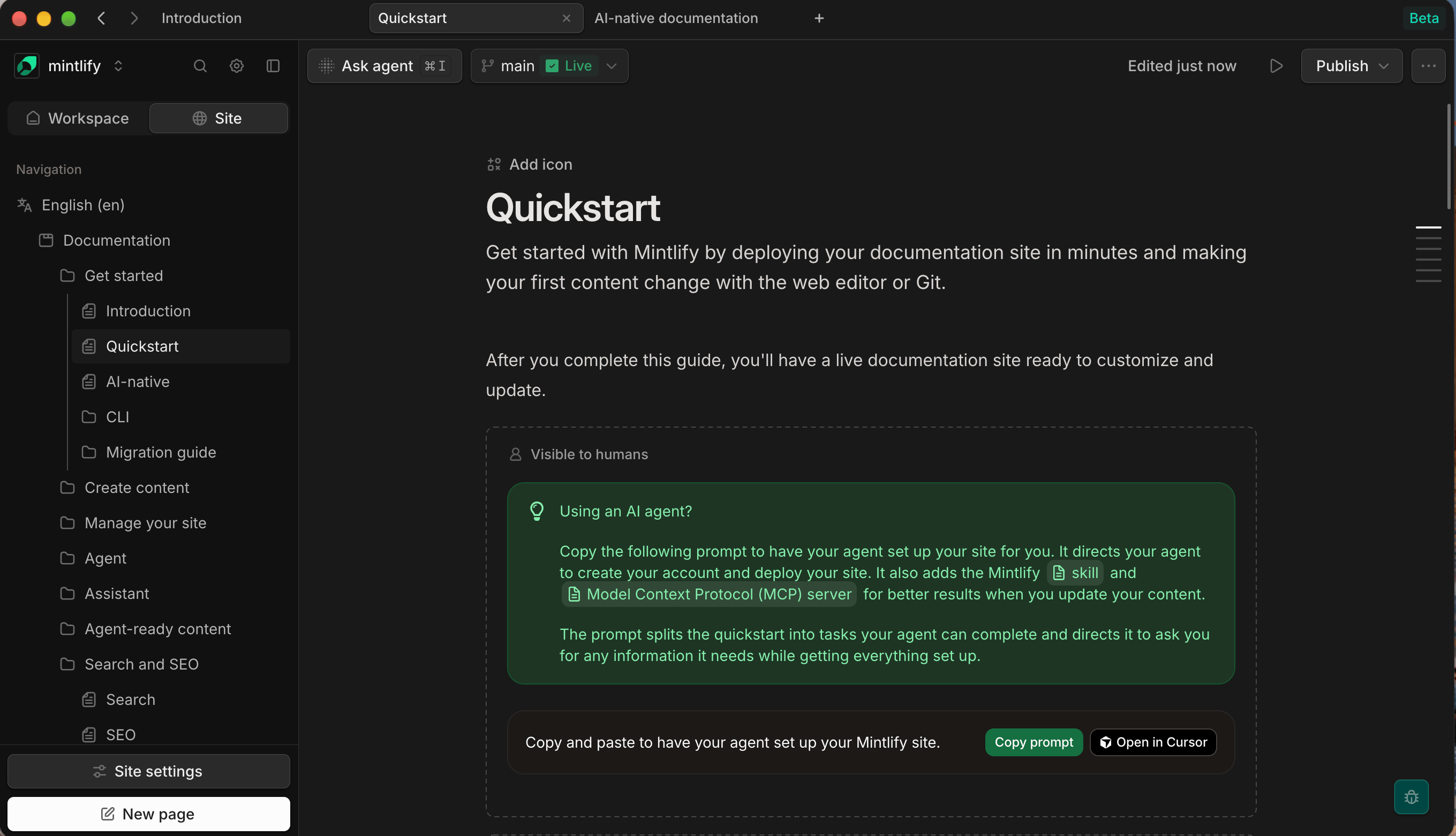
> Install the Mintlify desktop app for macOS, Windows, or Linux to use your dashboard and editor in a native window with tabs and keyboard shortcuts.
The desktop app is in beta and subject to change.
The Mintlify desktop app runs your [dashboard](https://app.mintlify.com) and [editor](/docs/editor/index) on your computer. Work in tabs or multiple windows with access to the same content and settings you access in the browser.
The desktop app updates content the same way the editor does. You can also [open Markdown files from your computer](#open-local-files) to edit them or copy them into a project. To preview your whole site locally, use the [CLI](/docs/cli/index).
 ## Install
Requires macOS 14 or later on Apple silicon.
1. Download the desktop app from [mintlify.com/desktop](https://mintlify.com/desktop).
2. Open the file.
3. Drag **Mintlify** to your **Applications** folder.
You can also install from the terminal.
```bash Install the desktop app theme={null}
curl -fsSL https://desktop.mintlify.com/install.sh | bash
```
The script installs to `/Applications`, or to `~/Applications` if you can't write to `/Applications`.
Requires Windows 10 or later, 64-bit.
1. Download the desktop app from [mintlify.com/desktop](https://mintlify.com/desktop).
2. Run the installer.
Requires an x86\_64 machine. The desktop app is available as an AppImage and a `.deb` package.
Download either file from [mintlify.com/desktop](https://mintlify.com/desktop) or install the AppImage from the terminal.
```bash Install the desktop app theme={null}
curl -fsSL https://desktop.mintlify.com/install.sh | bash
```
The script installs the app to `~/.local/share/mintlify-desktop`, adds a `mintlify-desktop` command to `~/.local/bin`, and adds Mintlify to your application menu.
AppImages require FUSE 2. If the desktop app doesn't start, install FUSE 2. On Ubuntu:
```bash Install FUSE 2 theme={null}
sudo apt install libfuse2
```
## Sign in
The desktop app signs you in with the Mintlify account you already use in your default browser.
1. Open the desktop app. The desktop app shows a **Log in to Mintlify** screen.
2. Click **Continue in browser**. Your default browser opens a Mintlify consent page that shows your account and organization.
3. Click **Approve**. To sign in to another organization, click **Use a different organization** first.
4. Return to the desktop app. The desktop app signs you in.
The desktop app and your browser share the same session. Signing out of one signs you out of the other.
### Sign in without your browser
Browser sign-in isn't available for some organizations, such as organizations that set a [maximum session lifetime](/docs/dashboard/session-security#maximum-session-lifetime). If the consent page says desktop login is not available, sign in inside the desktop app instead:
1. On the **Log in to Mintlify** screen, click **Log in here instead**.
2. Sign in the same way you sign in to your dashboard in your browser.
## Tabs and windows
Open each page you're working on in its own tab or window. Tabs and windows reopen where you left them when you restart the app.
Right-click a tab to duplicate it, copy its link, or close other tabs. Middle-click a tab to close it.
To show tabs in a sidebar instead of across the top of the window, change the tab layout in [Settings](#settings).
### Each tab has its own session
A new tab opens signed in to the same account and organization as the tab you opened it from. After that, each tab keeps its own session:
* Switching organizations in one tab doesn't change your other tabs, so you can work in different organizations side by side.
* Signing out or signing in to a different account only affects that tab.
To sign out everywhere, use **Clear all data** in [Settings](#settings).
### Links to other sites
Tabs only load the Mintlify dashboard and the services it uses for signing in, accessing credits for AI features, and connecting Git providers. Links to any other site open in your default browser.
## Open local files
Open a Markdown file from your computer to view and edit it in the editor. The desktop app opens `.md`, `.mdx`, `.markdown`, and `.txt` files up to 5 MB.
To open a file, click **Open File...** in the **File** menu or press Cmd + O. The file opens in a new tab.
* **Visual** mode renders the file with Mintlify components such as callouts, cards, steps, and code blocks.
* **Markdown** mode shows the raw source. Use it for content the visual editor can't render.
Press Cmd + S or click **Save** to write your changes back to the file. The desktop app keeps the file's frontmatter unchanged. Saving from Visual mode can reformat some Markdown, such as list markers and spacing.
Visual mode does not apply your site's theme or load snippets and relative images. Local file tabs don't reopen when you restart the app.
You don't need to sign in to open and edit local files.
### Copy a file to a project
When you're signed in, you can add a local file to one of your organization's projects as a new page.
1. Click **Copy to project**.
2. Select a project.
The desktop app opens the project in the editor in a new tab and adds the file as a new page at the end of your navigation. The page title and description come from the file's frontmatter. [Publish](/docs/editor/publish) the page like any other change.
## Keyboard shortcuts
On Windows and Linux, use Ctrl instead of Cmd.
| Action | Shortcut |
| :- | :- |
| New tab | Cmd + T |
| New page in a new tab | Cmd + N |
| Open file | Cmd + O |
| New window | Cmd + Shift + N |
| Close tab | Cmd + W |
| Close window | Cmd + Shift + W |
| Go to tab 1-9 | Cmd + 1-9 |
| Next tab | Ctrl + Tab |
| Previous tab | Ctrl + Shift + Tab |
| Back | Cmd + \[ |
| Forward | Cmd + ] |
| Reload | Cmd + R |
| Zoom in | Cmd + + |
| Zoom out | Cmd + - |
| Reset zoom | Cmd + 0 |
| Find in page | Cmd + F |
| Find next | Cmd + G |
| Find previous | Cmd + Shift + G |
| Copy page URL | Cmd + Shift + C |
| Open settings | Cmd + , |
For shortcuts inside the editor, see [Keyboard shortcuts](/docs/editor/keyboard-shortcuts).
## Settings
Open settings with Cmd + , on macOS or Ctrl + , on Windows and Linux.
* **Tab layout**: Show tabs across the top of the window (**Horizontal**) or in a sidebar (**Vertical**).
* **Check for updates**: Check for a new version of the app. See [Updates](#updates).
* **Clear all data**: Sign out of every tab, close all tabs, and reset settings. The app restarts.
The settings window also shows the app version.
## Updates
The app checks for updates when it starts and every four hours while it runs. When an update is available, an **Update** button appears in the tab bar.
To manually check for updates, click **Check for updates** in [Settings](#settings). You can also select **Check for Updates…** from the app menu. On macOS, it's under **About Mintlify** in the **Mintlify** menu. On Windows and Linux, it's at the bottom of the **File** menu. A dialog shows whether an update is available and lets you install it.
* **macOS**: Click **Update** to download and install the update in the app.
* **Windows and Linux**: Click **Update** to download the new version from your browser, then install it.
## Uninstall
1. Quit the desktop app.
2. Move **Mintlify** from your **Applications** folder to the Trash.
3. To remove your sign-in and settings, delete `~/Library/Application Support/Mintlify Electron`.
1. Open **Settings** > **Apps** > **Installed apps**.
2. Find **Mintlify** and click **Uninstall**.
3. To remove your sign-in and settings, delete `%APPDATA%\Mintlify Electron`.
If you installed the desktop app with the script, delete the files it created:
```bash Remove the desktop app theme={null}
rm -rf ~/.local/share/mintlify-desktop \
~/.local/bin/mintlify-desktop \
~/.local/share/applications/mintlify-desktop.desktop \
~/.local/share/icons/hicolor/512x512/apps/mintlify-desktop.png
```
If you installed the `.deb` package, remove it with your package manager.
To remove your sign-in and settings, delete `~/.config/Mintlify Electron`.
## Related topics
- [Guides](/docs/guides/index.md)
- [Examples](/docs/components/examples.md)
- [GitHub](/docs/deploy/github.md)
This documentation is built and hosted on [Mintlify](https://mintlify.com), a developer documentation platform.
## Install
Requires macOS 14 or later on Apple silicon.
1. Download the desktop app from [mintlify.com/desktop](https://mintlify.com/desktop).
2. Open the file.
3. Drag **Mintlify** to your **Applications** folder.
You can also install from the terminal.
```bash Install the desktop app theme={null}
curl -fsSL https://desktop.mintlify.com/install.sh | bash
```
The script installs to `/Applications`, or to `~/Applications` if you can't write to `/Applications`.
Requires Windows 10 or later, 64-bit.
1. Download the desktop app from [mintlify.com/desktop](https://mintlify.com/desktop).
2. Run the installer.
Requires an x86\_64 machine. The desktop app is available as an AppImage and a `.deb` package.
Download either file from [mintlify.com/desktop](https://mintlify.com/desktop) or install the AppImage from the terminal.
```bash Install the desktop app theme={null}
curl -fsSL https://desktop.mintlify.com/install.sh | bash
```
The script installs the app to `~/.local/share/mintlify-desktop`, adds a `mintlify-desktop` command to `~/.local/bin`, and adds Mintlify to your application menu.
AppImages require FUSE 2. If the desktop app doesn't start, install FUSE 2. On Ubuntu:
```bash Install FUSE 2 theme={null}
sudo apt install libfuse2
```
## Sign in
The desktop app signs you in with the Mintlify account you already use in your default browser.
1. Open the desktop app. The desktop app shows a **Log in to Mintlify** screen.
2. Click **Continue in browser**. Your default browser opens a Mintlify consent page that shows your account and organization.
3. Click **Approve**. To sign in to another organization, click **Use a different organization** first.
4. Return to the desktop app. The desktop app signs you in.
The desktop app and your browser share the same session. Signing out of one signs you out of the other.
### Sign in without your browser
Browser sign-in isn't available for some organizations, such as organizations that set a [maximum session lifetime](/docs/dashboard/session-security#maximum-session-lifetime). If the consent page says desktop login is not available, sign in inside the desktop app instead:
1. On the **Log in to Mintlify** screen, click **Log in here instead**.
2. Sign in the same way you sign in to your dashboard in your browser.
## Tabs and windows
Open each page you're working on in its own tab or window. Tabs and windows reopen where you left them when you restart the app.
Right-click a tab to duplicate it, copy its link, or close other tabs. Middle-click a tab to close it.
To show tabs in a sidebar instead of across the top of the window, change the tab layout in [Settings](#settings).
### Each tab has its own session
A new tab opens signed in to the same account and organization as the tab you opened it from. After that, each tab keeps its own session:
* Switching organizations in one tab doesn't change your other tabs, so you can work in different organizations side by side.
* Signing out or signing in to a different account only affects that tab.
To sign out everywhere, use **Clear all data** in [Settings](#settings).
### Links to other sites
Tabs only load the Mintlify dashboard and the services it uses for signing in, accessing credits for AI features, and connecting Git providers. Links to any other site open in your default browser.
## Open local files
Open a Markdown file from your computer to view and edit it in the editor. The desktop app opens `.md`, `.mdx`, `.markdown`, and `.txt` files up to 5 MB.
To open a file, click **Open File...** in the **File** menu or press Cmd + O. The file opens in a new tab.
* **Visual** mode renders the file with Mintlify components such as callouts, cards, steps, and code blocks.
* **Markdown** mode shows the raw source. Use it for content the visual editor can't render.
Press Cmd + S or click **Save** to write your changes back to the file. The desktop app keeps the file's frontmatter unchanged. Saving from Visual mode can reformat some Markdown, such as list markers and spacing.
Visual mode does not apply your site's theme or load snippets and relative images. Local file tabs don't reopen when you restart the app.
You don't need to sign in to open and edit local files.
### Copy a file to a project
When you're signed in, you can add a local file to one of your organization's projects as a new page.
1. Click **Copy to project**.
2. Select a project.
The desktop app opens the project in the editor in a new tab and adds the file as a new page at the end of your navigation. The page title and description come from the file's frontmatter. [Publish](/docs/editor/publish) the page like any other change.
## Keyboard shortcuts
On Windows and Linux, use Ctrl instead of Cmd.
| Action | Shortcut |
| :- | :- |
| New tab | Cmd + T |
| New page in a new tab | Cmd + N |
| Open file | Cmd + O |
| New window | Cmd + Shift + N |
| Close tab | Cmd + W |
| Close window | Cmd + Shift + W |
| Go to tab 1-9 | Cmd + 1-9 |
| Next tab | Ctrl + Tab |
| Previous tab | Ctrl + Shift + Tab |
| Back | Cmd + \[ |
| Forward | Cmd + ] |
| Reload | Cmd + R |
| Zoom in | Cmd + + |
| Zoom out | Cmd + - |
| Reset zoom | Cmd + 0 |
| Find in page | Cmd + F |
| Find next | Cmd + G |
| Find previous | Cmd + Shift + G |
| Copy page URL | Cmd + Shift + C |
| Open settings | Cmd + , |
For shortcuts inside the editor, see [Keyboard shortcuts](/docs/editor/keyboard-shortcuts).
## Settings
Open settings with Cmd + , on macOS or Ctrl + , on Windows and Linux.
* **Tab layout**: Show tabs across the top of the window (**Horizontal**) or in a sidebar (**Vertical**).
* **Check for updates**: Check for a new version of the app. See [Updates](#updates).
* **Clear all data**: Sign out of every tab, close all tabs, and reset settings. The app restarts.
The settings window also shows the app version.
## Updates
The app checks for updates when it starts and every four hours while it runs. When an update is available, an **Update** button appears in the tab bar.
To manually check for updates, click **Check for updates** in [Settings](#settings). You can also select **Check for Updates…** from the app menu. On macOS, it's under **About Mintlify** in the **Mintlify** menu. On Windows and Linux, it's at the bottom of the **File** menu. A dialog shows whether an update is available and lets you install it.
* **macOS**: Click **Update** to download and install the update in the app.
* **Windows and Linux**: Click **Update** to download the new version from your browser, then install it.
## Uninstall
1. Quit the desktop app.
2. Move **Mintlify** from your **Applications** folder to the Trash.
3. To remove your sign-in and settings, delete `~/Library/Application Support/Mintlify Electron`.
1. Open **Settings** > **Apps** > **Installed apps**.
2. Find **Mintlify** and click **Uninstall**.
3. To remove your sign-in and settings, delete `%APPDATA%\Mintlify Electron`.
If you installed the desktop app with the script, delete the files it created:
```bash Remove the desktop app theme={null}
rm -rf ~/.local/share/mintlify-desktop \
~/.local/bin/mintlify-desktop \
~/.local/share/applications/mintlify-desktop.desktop \
~/.local/share/icons/hicolor/512x512/apps/mintlify-desktop.png
```
If you installed the `.deb` package, remove it with your package manager.
To remove your sign-in and settings, delete `~/.config/Mintlify Electron`.
## Related topics
- [Guides](/docs/guides/index.md)
- [Examples](/docs/components/examples.md)
- [GitHub](/docs/deploy/github.md)
This documentation is built and hosted on [Mintlify](https://mintlify.com), a developer documentation platform.